

Categories
Real Estate Market UpdatesPublished October 10, 2026
October 2026 - What the Fed, Prop 37, and September Sales Mean If You Are Ready to Sell

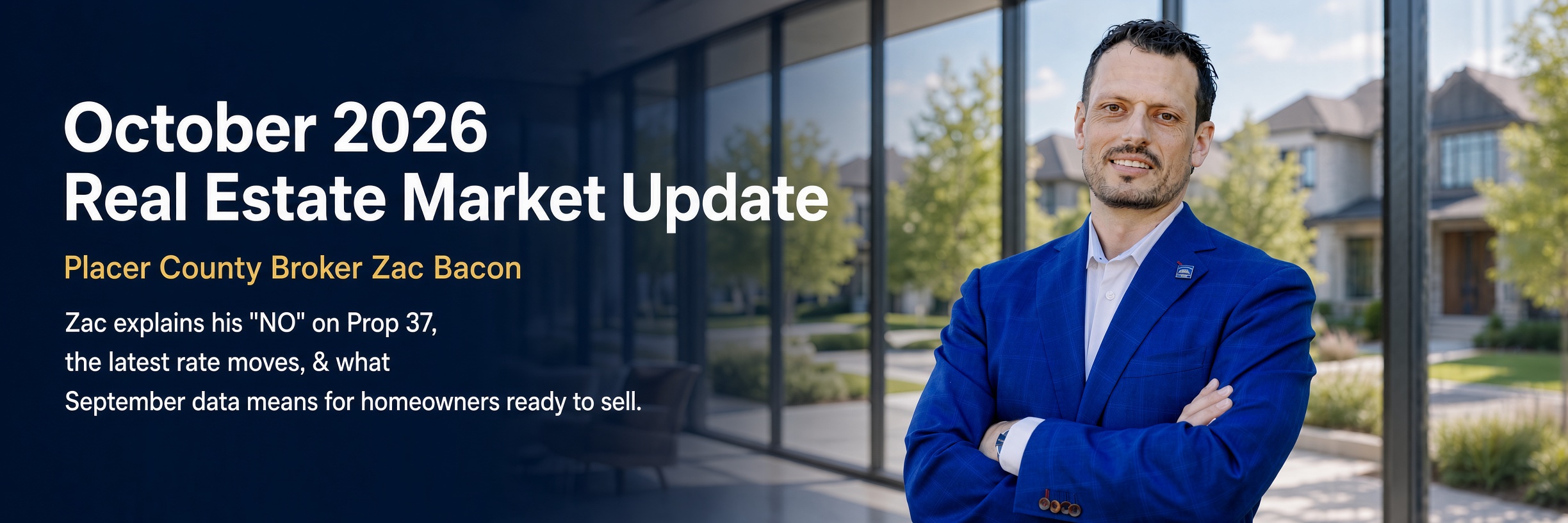
Less than a month from the November 3 election, the question I hear most from Placer County homeowners is not “who are you voting for?” It is “should we sell now, or wait?”
That is the right question. Rates just moved higher, buyers are slower, and one statewide measure on the ballot is being sold as a fix for housing. None of that changes the job in front of a seller: price the home to the market that exists, prepare it so it does not sit, and run a transaction that closes without drama.
Here is how I am reading the next few weeks, including a clear no on Proposition 37, and what September’s numbers actually mean if you own a home in Roseville, Rocklin, Lincoln, Granite Bay, Loomis, Auburn, or anywhere else in Placer County.
Proposition 37: more buying power is not the same as more homes
Proposition 37, the California Middle-Class Homeownership and Family Home Construction Act, is the housing measure on the November 3 ballot. A yes vote would let the California Housing Finance Agency issue up to $25 billion in revenue bonds and offer eligible buyers a fixed-rate second mortgage for up to 17% of the price of a qualified new home. The buyer would still need at least 3% of their own funds. Eligibility is limited: California residency, owner-occupancy, income caps, and a price ceiling that lands around $1 million to $1.5 million depending on the county. The bonds are meant to be repaid by those mortgage payments, not by taxpayers.
The California Association of Realtors supports it. At this time, I do not.
I understand the appeal. The current state of housing is not ideal, and a 3% down payment plus a state-backed second looks like relief. It is the wrong fix for California right now, for three reasons.
First, it adds purchasing power without adding enough supply. Qualified homes are new construction or the first sale of a converted property, not the resale homes most Placer County sellers own. Pumping financed demand into a tight new-home pipeline is the same pattern we saw in 2020 and 2021. Look at what that did to prices and inflation.
Second, buyers still pay interest on the money. A second mortgage is not a gift. It is another loan, with another payment, on top of a first mortgage that is already expensive.
Third, more subsidized demand can push values up and price out the buyers the program did not reach. It does not fix the fundamental issue, which is that we do not build enough homes where people want to live, at a cost the middle of the market can carry.
I am also curious who the private bond buyers turn out to be, and how loose the lending guidelines get once the program is stood up. “Not taxpayers” only holds if defaults stay inside the bond structure. That is a claim worth watching, not a reason to vote yes.
## The rate backdrop sellers should actually care about
Over the past month the Federal Reserve raised the federal funds target by 25 basis points to 3.75–4%. It was the first increase in three years. The Fed pointed to inflation still above 2% and a labor market near full employment.
The data under that decision was mixed. September payrolls came in far weaker than expected, unemployment edged up to 4.2%, and wage growth slowed to 3%. August core PCE cooled to about 3%. That mix left markets less sure of further hikes, even as the September minutes showed unanimous support for tighter policy. Bonds had their worst month in years. The 10-year Treasury yield posted its biggest monthly rise since 2022, and the S&P 500 fell in September even as it logged a second straight quarterly gain.
Globally, the OECD said growth is holding up better than it expected in June, despite high oil prices tied to the Iran conflict, but warned a prolonged Middle East war could still hit activity. European inflation re-accelerated in September.
For housing, the number that matters is the mortgage rate. The average 30-year reached 7.4% in early October, the highest since late 2023. Existing-home sales fell in August to a 3.98 million annual pace, the slowest in more than a year, even as the median price rose to an August record of $429,100. A record share of September listings carried a price cut.
Higher rates do not automatically mean home values collapse. They do mean fewer buyers can qualify, and the ones who can are asking for more.
Placer County in September: slower, not broken
Locally, higher rates and thinner affordability are doing exactly what you would expect. Sales volume is down. Price reductions are more common. Buyers have not disappeared, but they are stepping back, writing lower offers, and asking for concessions. Active inventory is easing the way it usually does in fall. Months of inventory are still rising, because closed sales fell faster than the listing count.
I watch the year and the month together. One month is not a trend.
**Tri-county, September**
- Homes for sale rose 2.7% as buyer demand cooled and inventory kept building.
- Pendings dropped 12.1%.
- Closed sales fell 6.1%. That is a normal end-of-summer shift, and it feels sharper because rates moved quickly.
- New listings and inventory are higher than a year ago. Pending and sales volume is just under 10% lower than September 2025.
- Days on market moved from 42 to 45.
- List-to-sold held at 97% for a second month.
- The median sold price for single-family homes was unchanged at $600,000, still 2.6% above last September.
- Months of inventory rose from 2.7 to 2.9. Typical for the fourth quarter. I get more concerned if it sits above 3 for an extended stretch.
**Placer County, September**
- Residential homes for sale fell 1.8%. Pendings fell 8.1% under the rate pressure.
- Homes sold fell a moderate 6.2% from August, and 13% from September 2025.
- Days on market rose 8.3% to 52. That is still under the 55 days of a year ago.
- List-to-sold held at 96%, the same as last year.
- The median sold price for single-family homes dropped 1.9%, from $693,000 to $680,000, and is still 4.6% above the same month last year.
- Months of inventory rose 7.3%, from 2.7 to 2.9, about 15.7% more supply relative to the sales rate than last September.
Sales prices can print “up” or “down” versus last year depending on which month you pick. Over the last three years, Placer County values are roughly flat. On a yearly basis, the median often swings 3% to 5% just from seasonality. That is why I do not cherry-pick a single print, and why I tell buyers and sellers not to try to time this market. Too many of the inputs are outside anyone’s control.
September continued the slower 2026 pattern. For the near term, expect more of the same. Better volume or higher prices need lower rates, or incomes that rise enough to offset the payment. I do not see Placer County prices dropping by any meaningful amount in the near future. We are in a mediocre market, not a falling one. There is still a way to hit a goal. It just takes a more precise plan than it did in 2021.
## What this means if you are ready to sell
A 96% list-to-sold ratio and 52 days on market is not a crash. It is a market that punishes a stale price and rewards a home that is ready on day one.
If you are selling in Placer County this fall, three things decide the outcome more than the Fed does.
Price to the closed sales from the last 30 to 45 days, not to the neighbor who sold in spring. At a 96% list-to-sold ratio, a listing that starts 5% high usually becomes a price cut, then a lower offer, then concessions. The clean sale is usually the one that was priced correctly the first week.
Expect negotiation. Buyers who can still qualify at 7.4% are asking for credits, repairs, and rate help. A smooth transaction is not the one with zero requests. It is the one where those requests were anticipated, the inspection items were already handled, and the response is fast.
Do not wait for a perfect rate headline. Inventory at 2.9 months is balanced-to-soft, not flooded. Homes that show well and are priced to the median trend are still selling. Homes that chase last year’s number are the ones stacking up.
That is the work I do with Placer County sellers: a pricing opinion tied to the closed data, a prep list before the first photo, and a negotiation plan so the deal does not stall between acceptance and recording. Mortgage-side experience helps here. When a buyer asks for a credit, I can tell you whether it actually changes their payment, or whether it is just a number on a form.
If you want the local PDF for your zip code, comment with the zip and I will send it. If you are ready to sell and want the path that is boring in the best way, call or text me at (916) 677-9813 or email zac@quantumcalifornia.com. Quantum Real Estate is in Roseville. I have been doing this in Placer County since 2003, DRE 01385370.
Zac Bacon
Broker Associate, Quantum Real Estate
Roseville and Placer County
---
Two edits worth knowing before you publish: Proposition 37 is a second-mortgage program for qualified new homes, not a 17% down-payment loan on every resale, so the post says that. And the California Association of Realtors line is kept as your statement. The official voter guide’s listed supporters are the United Nurses Associations of California, the California Conference of Carpenters, and Treasurer Fiona Ma, so confirm the CAR endorsement before the post goes live.

Zac Bacon
Broker Associate | Zac Bacon | Quantum Real Estate
or another way